Major Updates, AWOS, Traffic, NAS and more
Published on November 18 2026 by Torrey Systems
ATIS Relay update, November 2026
It's been over a year since I posted anything here, and the site has changed a lot in the last six weeks, so I figured I should write up what's different. Almost all of this shipped between early October and today, November 17. If you mostly use ATIS Relay to check the ATIS before you drive to the airport, the first two sections are the ones you'll notice. The rest is for people who like flight data or are building something with it.
The site looks different
On October 9 I put up a redesign of the public site. It's lighter and easier to read, the coverage map stayed, and the home page now starts with an airport search and a stack of live ATIS cards. Dark mode followed a couple of days later. It follows your system setting, and you can override it from the appearance setting on your account page. The Zulu clock under the nav went missing in the redesign and came back on October 11.
Airport pages got reorganized too. The ATIS is at the top, the transcript sits above the METAR, and the airport facts box moved below the NOTAMs. I also started pulling in the FAA's airport data files and the Chart Supplement, so airport pages now show the Chart Supplement entry along with the rest of the airport info.
NOTAMs were broken for a stretch in early October because the FAA retired the old NOTAM API this year. I moved everything to the FAA's new NOTAM system on October 9. If that feed is down, the NOTAMs card now says so quietly rather than showing an error page.
The site was also slower than it should have been. In early November a monitoring alert caught the home page taking more than five seconds to load when crawlers were hitting it at the same time as some scheduled jobs. I spent November 11 through 13 caching more and spreading the background work out over the hour, and an uncached home page now renders in about a second.
A smaller thing that was annoying people was that closing your browser signed you out. As of November 14 you stay signed in for 30 days. And today I merged pricing into one page and replaced the old FAQ and How to use pages with a single Help page.
Getting ATIS at airports without D-ATIS
A lot of what ATIS Relay does is for airports that don't publish D-ATIS, where the usual way to get the ATIS is to call the phone line or listen on frequency. Since October 11, subscribers can request a fresh report right from the airport page on the website, the same as in the app or by text. It works at AWOS and ASOS airports too, and when an ATIS line says the tower is closed it now falls back to the automated weather line.
I spent a good part of October on transcription. Broadcasts loop, so the system now assembles one clean pass, gets the information letter right more often, fixes airport names that come out garbled, and trims the repeats. There's a thumbs up and down on each transcript now, and I do read those.
Schedule ATIS got reworked on October 23. You pick a time, it fetches the report for you, retries up to three times, and gives the credit back if it still can't get one. On November 16 I added the option to tie a scheduled report to an IFR flight by tail number, so the departure ATIS arrives shortly before you leave and the destination ATIS arrives as you get close.
One fix worth calling out on its own: airports that only have an FAA identifier and no ICAO code, like 1G0 (Wood County, Ohio), couldn't complete a phone or text AWOS request. Someone ran into it on November 11, and it was fixed on November 14.
Community stations
Some airports are covered by small Raspberry Pi receivers that record the ATIS off the air. In October I rebuilt the Host a station page with a do-it-yourself parts list and rough part costs, and approved station hosts now get a complimentary ATIS Relay Plus subscription.
The stations taught me a few things. From October 2 to October 9 they were uploading empty audio files. I assumed it was Wi-Fi. Once the Pis started reporting their own status it was clearly power: the board was undervolted and throttling. Now there's an alert when a station has been offline for 45 minutes. And as of November 16, when a tower closes and the station picks up the closed-tower broadcast, the card says the tower is closed and shows the CTAF, where before it would go blank or keep showing an old letter.
If you're near an airport without D-ATIS and want to host one, everything is at atisrelay.com/host.
Flights, traffic and NAS status
This is the newest part. Most of it went live on November 16 and 17, so expect some rough edges.
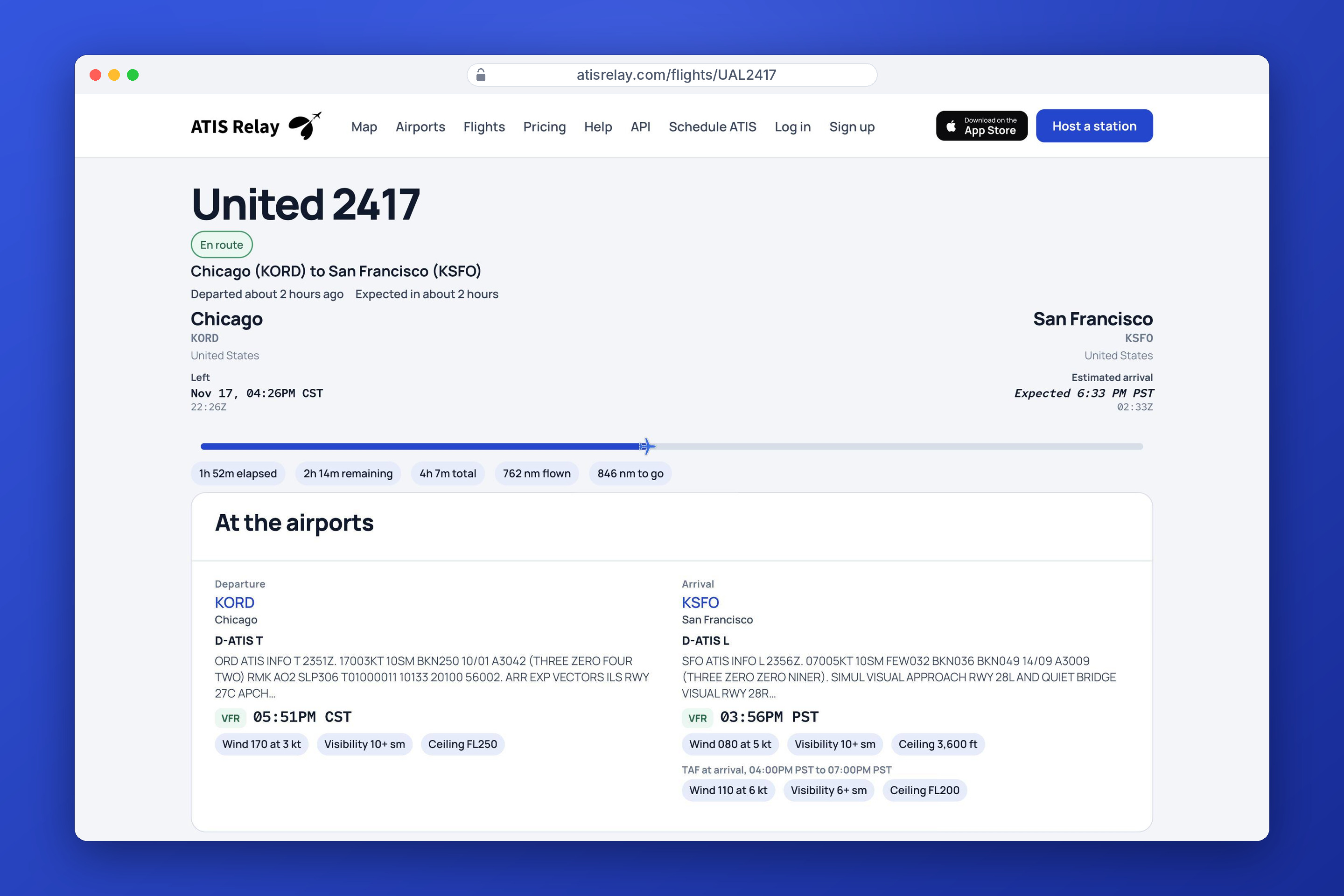
You can look up a flight by number at atisrelay.com/flights. It shows the published US schedule when there is one, typical times from flights we've seen, and the live position once it's airborne. Flight pages also show the weather at both ends, including the D-ATIS or latest ATIS and the METAR, plus any SIGMETs or AIRMETs that cross the route. They give a predicted arrival time, and if a ground stop or delay program is holding the flight up, a plain explanation of why.
There's a live aircraft map at atisrelay.com/live. Airport pages now have a small traffic map covering 50 nm around the field, with arrivals and departures below it, placed after the ATIS so it doesn't get in the way.
There's also a NAS status page at atisrelay.com/nas that pulls delays, TFRs, SIGMETs and AIRMETs into one place. For about a day there was a yellow NAS banner across the whole site, and it was showing up for things nobody cares about. As of this afternoon it only appears for major disruptions at the big airports or across the whole system.
For developers
Since mid-October you can create your own API key on the site. A free key covers D-ATIS, METAR and airport data and includes 1,000 live traffic requests a month. The paid plans and the per-request rates are on the pricing page.
The API grew a lot this week. On top of ATIS there are now endpoints for airports, TAFs, Chart Supplement text, AWOS, NOTAMs, SIGMETs, AIRMETs, PIREPs, live traffic, and flow programs like ground stops and ground delay programs. There's an OpenAPI spec at atisrelay.com/openapi.json and a getting-started guide at atisrelay.com/getting-started with examples you can copy and paste.
I also put up a read-only MCP server at atisrelay.com/mcp, so you can point an AI assistant at it and ask about ATIS, weather, NOTAMs or traffic. It has 30 tools, and it never places a phone call. You can try it without a key for up to 100 tool calls a day, and as of today you can sign in with your ATIS Relay account from apps that support that, so you don't have to paste a key.
Last, there's a page at atisrelay.com/compare that puts ATIS Relay's prices next to the published prices for FlightAware AeroAPI, Cirium and AirNav RadarBox. I tried to give them fair credit for what they do well.
That's most of it
There were a lot of smaller fixes I didn't list here. If something looks wrong, or there's an airport you'd like covered, the feedback form on the site comes straight to me.
- Ford